AssetStream
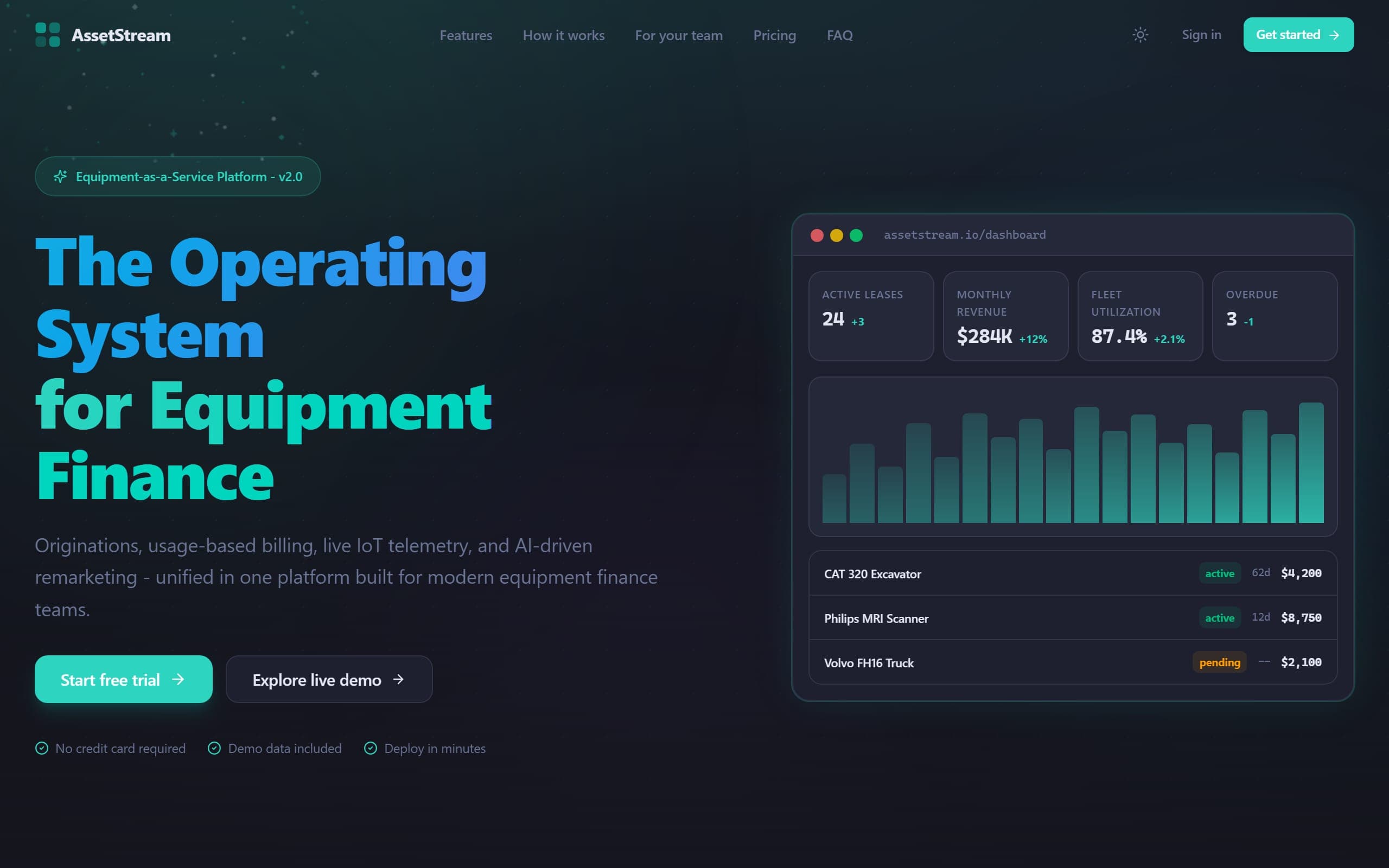
An operating system for equipment finance: leases, IoT-metered billing, risk scores and AI-guided remarketing, under one roof.
FBN.2026.03
AssetStream
Full-stack engineer, sole build
Django 5, Django REST Framework, Celery, Redis, 2026
1
command to raise the entire stack
8
backend domains, from originations to remarketing
3
roles served: admin, analyst and lessee
6
containers orchestrated in concert
The problem
Enterprise asset finance still runs on opaque legacy systems: leases in one place, usage data in another, and the value of a returning machine decided by instinct.
The approach
A Django REST core organises the business into originations, servicing, payments, remarketing and workflow domains. Celery workers on Redis ingest equipment telemetry and close invoices every cycle; a scikit-learn regression prices each machine at the end of its lease; an AI engine on Groq's Qwen3-32B scores risk, anticipates maintenance and answers analysts in plain language. A Next.js 15 dashboard fronts the whole estate, and the full stack rises with a single docker compose command.
The outcome
The complete asset-finance lifecycle, from origination to remarketing, running on Render in production and reproducible on any laptop in one command.
What it does
4 capabilitiesThe lease, end to end
Origination, servicing and end-of-term decisions follow the shape of real enterprise asset-finance workflows.
Billing by the hour of use
Celery workers turn live equipment telemetry into invoices at the close of every cycle.
A price for the return
A regression model values each machine at the end of its lease, so remarketing opens with a number instead of a guess.
An analyst on call
Risk scoring, maintenance prediction and a conversational assistant run on Groq's Qwen3-32B.
The strata
How it standsFrontend
Next.js 15, TypeScript, Tailwind v4 and TanStack Query dashboards
API
Django 5 and DRF across originations, servicing, payments and remarketing
Async engine
Celery on Redis: telemetry ingestion and invoice generation
Intelligence
scikit-learn resale valuation and a Groq-hosted AI engine
Infrastructure
PostgreSQL 16 and Nginx, orchestrated with Docker Compose, live on Render
The judgments
The reasoning, on the recordChose
Celery and Redis workers
over billing inside the request cycle
Telemetry arrives continuously and invoices close per cycle. A queue keeps the API responsive and lets billing jobs retry safely.
Chose
A scikit-learn regression
over a deep model
Resale value turns on a handful of tabular features. A regression explains itself to a finance team and retrains in seconds.
Chose
Docker Compose
over Kubernetes
Six containers on one host did not need an orchestrator. Raising the whole stack with a single command mattered more.
The cabinet
Captured from the live build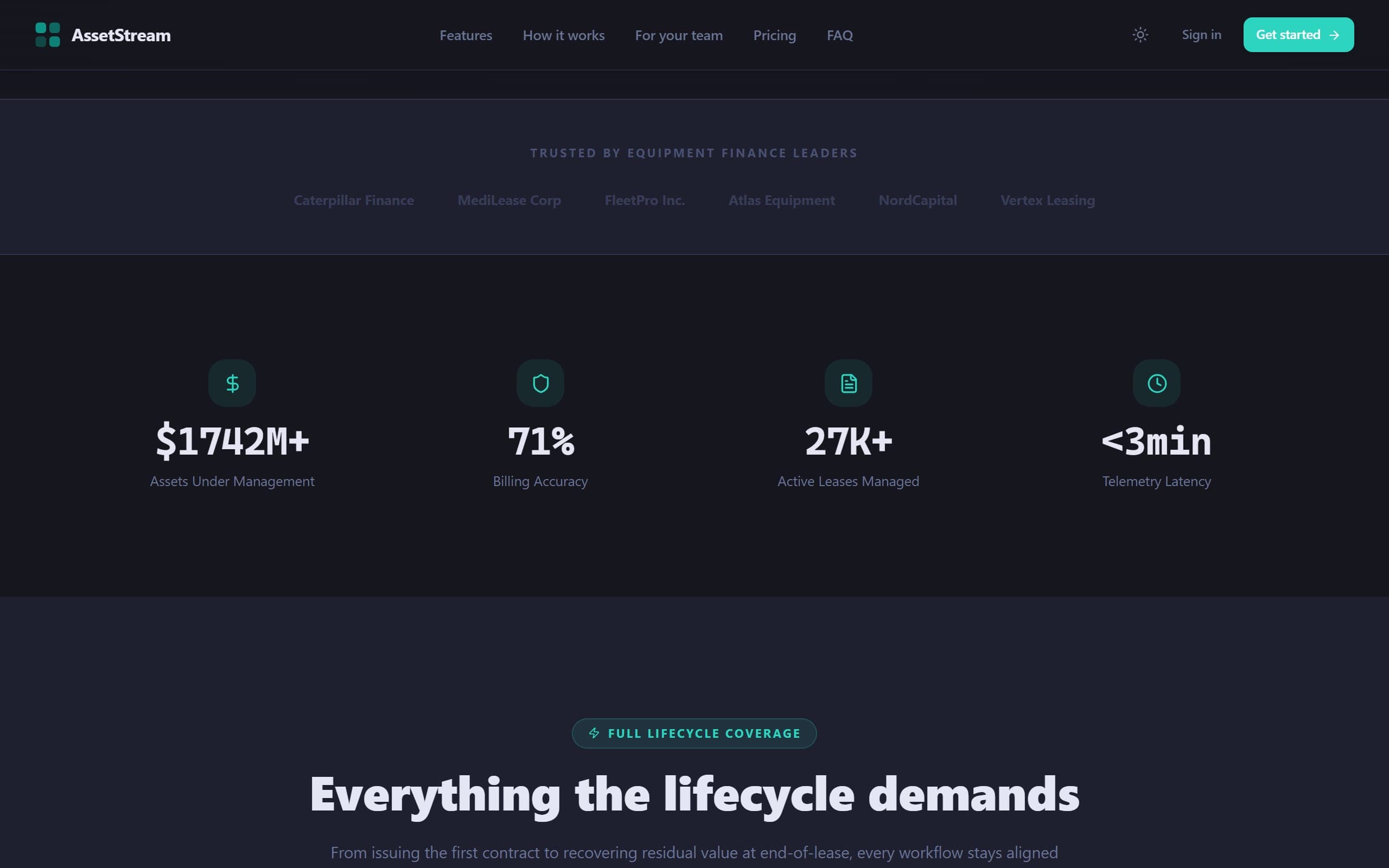
AssetStream, plate I
Screen capture, 2560 × 1600
assetstream-frontend.onrender.com, MMXXVI

Next exhibit — IV
AskVid-Pro